 Image 1 of 1
12” x 12” Matted Print
The universe, according to the Navajo, is a delicate balance between many powerful forces, each with the potential for both good and evil. If this delicate balance is upset, even unintentionally, misfortune or illness for the transgressor is the result. To restore the disrupted order and thereby cure the disease or problem, a Navajo medicine man or hataalii is called upon to perform the appropriate ceremony or "Chant Way". These rituals are so complex that most hataalii rarely master more than two in a lifetime. They can take anywhere from one to nine days and involve many prayers and offerings, medicine tools and hundreds of songs or chants. They also include the all-important sand painting.
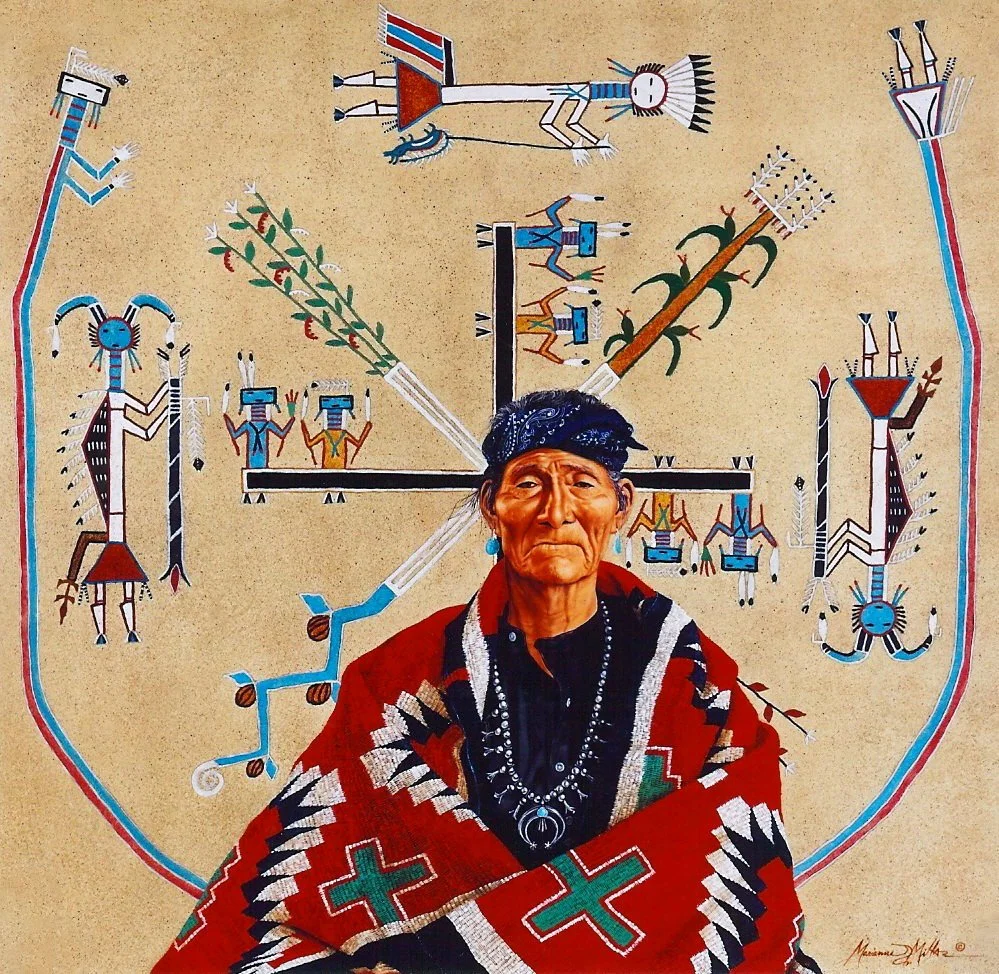
In this image of the sand painting, one can see the whirling logs represented by the black cross set in the middle of the piece and outlined first in white to signify the foam, and then in yellow to represent pollen cast on the water. The four sacred plants of the Navajo; corn, squash, beans, and tobacco, also radiate from this center and are flanked by two horned and humpbacked gods called Ghaan'ask'idii or Harvest God. At the top of the image, which is also the eastern entrance, is Talking God. Encircling the other three sides is Naats'iilid, the rainbow deity who guards the southern, western, and northern sides of the painting.
Click on Photo to view Full Image
12” x 12” Matted Print
The universe, according to the Navajo, is a delicate balance between many powerful forces, each with the potential for both good and evil. If this delicate balance is upset, even unintentionally, misfortune or illness for the transgressor is the result. To restore the disrupted order and thereby cure the disease or problem, a Navajo medicine man or hataalii is called upon to perform the appropriate ceremony or "Chant Way". These rituals are so complex that most hataalii rarely master more than two in a lifetime. They can take anywhere from one to nine days and involve many prayers and offerings, medicine tools and hundreds of songs or chants. They also include the all-important sand painting.
In this image of the sand painting, one can see the whirling logs represented by the black cross set in the middle of the piece and outlined first in white to signify the foam, and then in yellow to represent pollen cast on the water. The four sacred plants of the Navajo; corn, squash, beans, and tobacco, also radiate from this center and are flanked by two horned and humpbacked gods called Ghaan'ask'idii or Harvest God. At the top of the image, which is also the eastern entrance, is Talking God. Encircling the other three sides is Naats'iilid, the rainbow deity who guards the southern, western, and northern sides of the painting.
Click on Photo to view Full Image