 Image 1 of 1
Various Sizes - Matted Prints
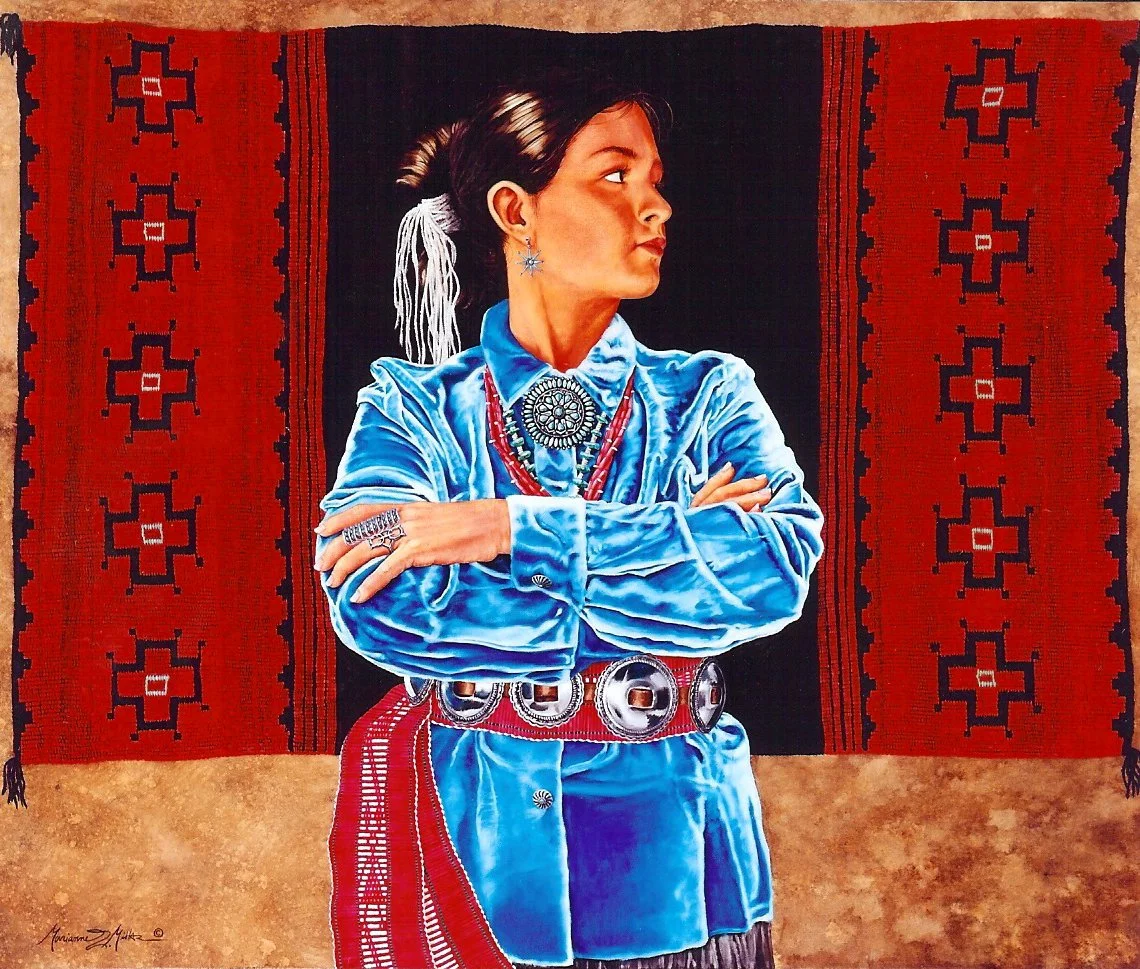
In the American Southwest lies the largest Native American reservation in the country, the Navajo Nation. Many Navajo still live today in small, scattered family groups, residing in traditional hogans, raising sheep, and using their wool to produce magnificent weavings of many colors and designs. The weaving shown in the background is half of a traditional woven dress worn by Navajo woman. This kind of dress would be worn length wise and sewn together on the sides to its twin, making a matching front and back. Such a dress was worn by the Navajo ladies prior to the late 1800's.
What we see today as traditional Navajo clothing of velvet shirts and calico skirts, is ironically an adoption of what the Anglo wives of U.S. soldiers wore in the 1860's. The Navajo women may have adopted this look but they also adapted it to their own culture by layering their dress with such things as Navajo silver-work, turquoise and coral jewelry, the traditional "chongo" or hair wrap, and the traditional woven sash.
Click on Photo to view Full Image
Various Sizes - Matted Prints
In the American Southwest lies the largest Native American reservation in the country, the Navajo Nation. Many Navajo still live today in small, scattered family groups, residing in traditional hogans, raising sheep, and using their wool to produce magnificent weavings of many colors and designs. The weaving shown in the background is half of a traditional woven dress worn by Navajo woman. This kind of dress would be worn length wise and sewn together on the sides to its twin, making a matching front and back. Such a dress was worn by the Navajo ladies prior to the late 1800's.
What we see today as traditional Navajo clothing of velvet shirts and calico skirts, is ironically an adoption of what the Anglo wives of U.S. soldiers wore in the 1860's. The Navajo women may have adopted this look but they also adapted it to their own culture by layering their dress with such things as Navajo silver-work, turquoise and coral jewelry, the traditional "chongo" or hair wrap, and the traditional woven sash.
Click on Photo to view Full Image