 Image 1 of 1
12” x 12” Matted Print
One of the greatest Crow chiefs that worked to improve the relations between his tribe and the growing American nation was Plenty Coups. A figure of both fame and controversy, Plenty Coups belonged to the last generation of Indians to come of age as free men and to earn the rank of chief through acts of bravery. "A boy never wished to be a man more than I," he said of his ambitions. "How I wished to count coup, to wear an eagle's feather in my hair, to sit in council."
Fueled by a dream that he would have no children of his own but instead would be father to all the Crow peoples, Plenty Coups rose quickly, proving himself in battle. He became chief of one of the largest of his tribe's bands when he was still in his thirties. In 1876 he was one of the leaders of the combined Crow-Shoshone force credited with saving General George Crook from defeat by the Sioux in the Battle of the Rosebud. "The soldier-chiefs will not forget that the Crow came to their aid," the chief promised his warriors.
Indeed, thanks in large part to their early decision to ally themselves with the whites, the Crow tribe largely avoided the military punishment that was meted out to their deadly enemies. The Crow were among the few Native American nations to remain intact on one reservation, having retained a portion of their ancestral homeland.
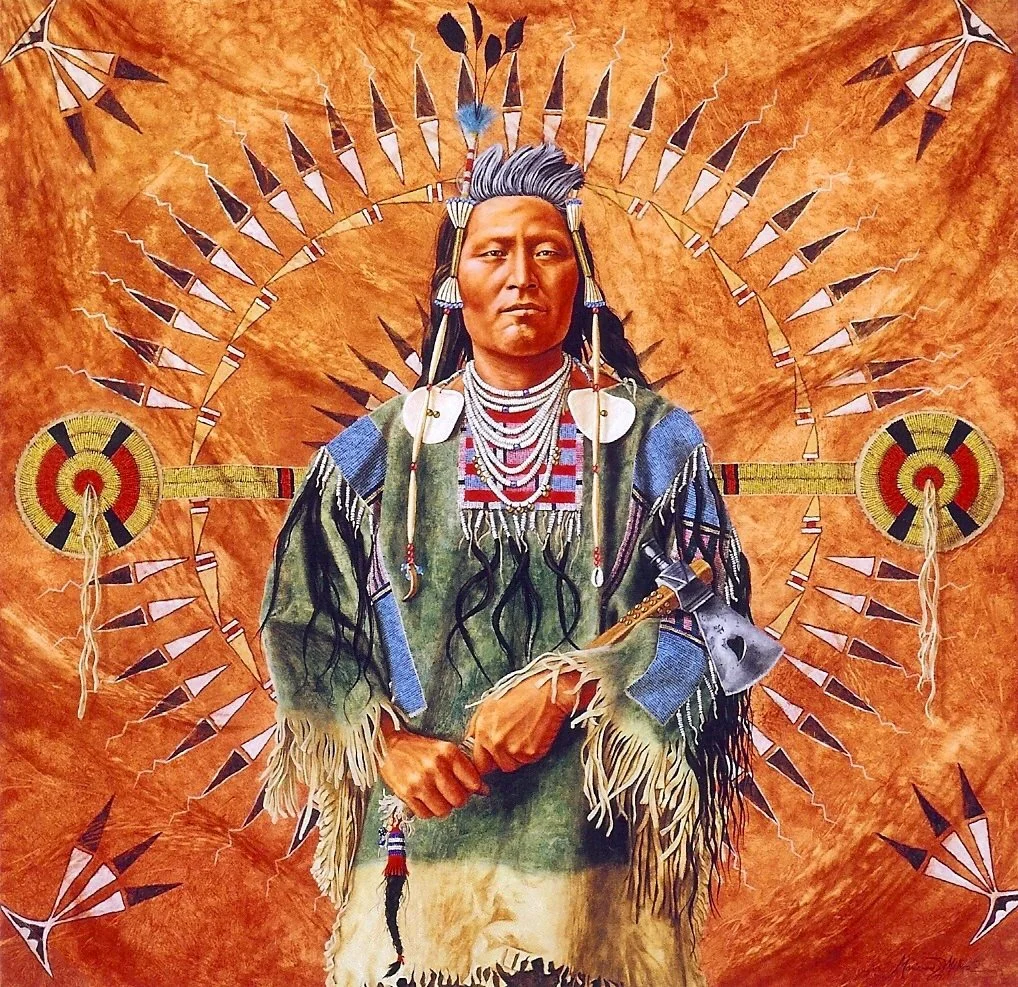
In this painting Plenty Coups stands in front of a magnificently painted and beaded buffalo skin robe. Characteristic of men's robes on the northern Plains, this red stained robe is painted with the
stunning "black war bonnet" pattern, consisting of concentric circles of small, radiating, black and white "feathers." These "feathers" are symbolic of the vaunted coup feathers worn in a warrior's war bonnet signifying specific acts of bravery.
Click on Photo to view Full Image
12” x 12” Matted Print
One of the greatest Crow chiefs that worked to improve the relations between his tribe and the growing American nation was Plenty Coups. A figure of both fame and controversy, Plenty Coups belonged to the last generation of Indians to come of age as free men and to earn the rank of chief through acts of bravery. "A boy never wished to be a man more than I," he said of his ambitions. "How I wished to count coup, to wear an eagle's feather in my hair, to sit in council."
Fueled by a dream that he would have no children of his own but instead would be father to all the Crow peoples, Plenty Coups rose quickly, proving himself in battle. He became chief of one of the largest of his tribe's bands when he was still in his thirties. In 1876 he was one of the leaders of the combined Crow-Shoshone force credited with saving General George Crook from defeat by the Sioux in the Battle of the Rosebud. "The soldier-chiefs will not forget that the Crow came to their aid," the chief promised his warriors.
Indeed, thanks in large part to their early decision to ally themselves with the whites, the Crow tribe largely avoided the military punishment that was meted out to their deadly enemies. The Crow were among the few Native American nations to remain intact on one reservation, having retained a portion of their ancestral homeland.
In this painting Plenty Coups stands in front of a magnificently painted and beaded buffalo skin robe. Characteristic of men's robes on the northern Plains, this red stained robe is painted with the
stunning "black war bonnet" pattern, consisting of concentric circles of small, radiating, black and white "feathers." These "feathers" are symbolic of the vaunted coup feathers worn in a warrior's war bonnet signifying specific acts of bravery.
Click on Photo to view Full Image